
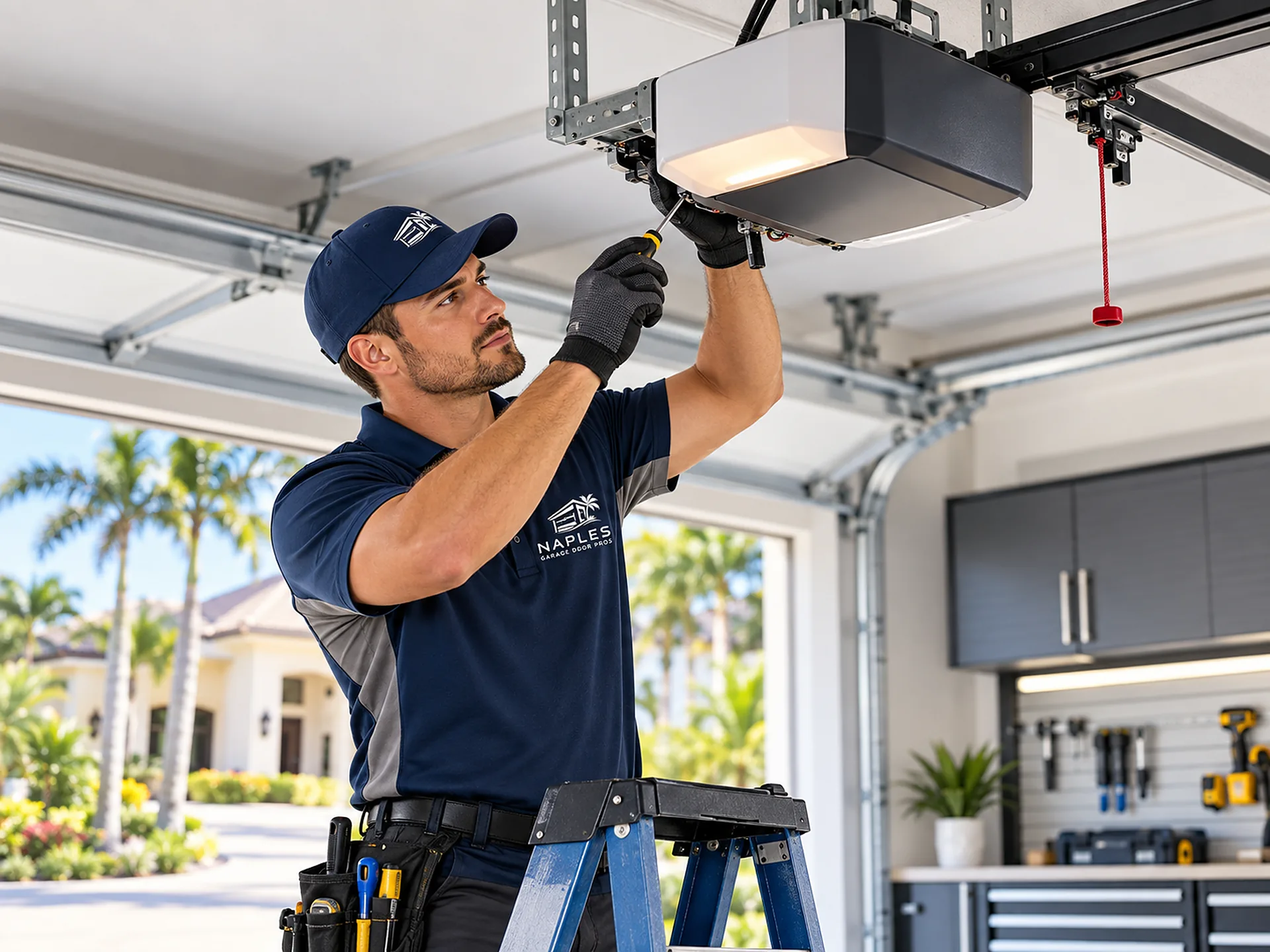
Opener dead, beeping or humming? We start at the plug.
A dead opener often turns out to be a tripped GFCI or a pulled release, and now and then a broken spring too heavy for the motor. We rule those out before replacing any part of the opener, and we say so when the fix is one you can make yourself.
- On site: About 1 hour (repair) or 2 to 3 hours (new opener)
- Florida license CGC15***92
Signs this is your problem
- No light, no sound, often right after a storm or a power cut.
- It chirps or beeps every so often, and the door still works.
- You hear a hum, and the door sits still.
- The chain or belt travels and the door stays put.
- The wall button works and the remotes don't: see remotes and keypads.
- It labors and the door hardly rises: rule out a broken spring first.
- It reverses before the floor: check the safety sensors. Something else? The symptom guide covers it.
Why it beeps
An opener with a battery backup chirps when that battery is weak or at the end of its life, and some also flash a light on the wall control. It's a reminder, not a breakdown: the opener keeps running on house power. The batteries are a wear item, and a hot garage shortens their life. If the beeping goes on with a new battery, the charger inside the opener is the next suspect.
Battery backup: useful, not required
You may read that Florida requires a battery backup on openers. The rule people have in mind is a California law (SB 969); here it's your choice. It earns its place in Collier: after Milton in October 2024, the National Weather Service reported most of the county without power (NWS report). For anyone who uses the garage as the main way in, or who can't be without the car in a blackout, a backup keeps the door running for a limited number of trips. Test it before hurricane season.
When salt water reached the opener
During Ian, the surge in Naples reached 6 to 9 feet above the ground (National Hurricane Center report), and water got into homes and garages along the coast. The motor unit on the ceiling often stays dry, but the wall button, the sensors, their wires and the outlets sit low, and salt keeps eating at metal after the water leaves.
If water reached the outlet the opener plugs into, leave it unplugged: the outlet and the circuit behind it are a job for a licensed electrician first. From the plug on, we test the logic board, each wire run, the sensors and the drive. A board that sat in salt water is usually replaced; a motor that stayed dry can often keep working.
Fix it or replace it
Our recommendation comes with the reason. Wear parts such as the gear that drives the chain, the capacitor that starts the motor or the wall button get replaced, and the opener goes back to work in about an hour. A new opener is the better call when the motor has burned out, or when the logic board for an older model can't be found. When the call is close, you see both options written down side by side. Before a new opener goes up, we check which remotes, which keypad and which car button of yours will pair with it.
Questions about openers & battery backup
Most often the backup battery is low or worn out. The opener keeps working on house power, and a new battery stops the beeping; if it doesn't, the charger inside the opener needs a look.
No. The requirement people cite is California's SB 969, not a Florida law. In Collier a backup is optional, and worth it for anyone who can't be without the car during a blackout.
Sometimes. If the motor unit stayed above the water, the opener often needs only new sensors, wiring or a wall button. A logic board or motor that went under salt water is usually replaced, and the outlet needs an electrician before anything is plugged back in.
Two to three hours on site. That includes hanging the rail, setting the travel limits and the force, mounting the sensors and pairing the remotes, keypad and car button you keep.
One number, from the first call to the sign-off
Calls and texts to (239) 990-8829 are answered by a person, day and night. Text us a picture of your door, or of the sticker on your opener, and we'll tell you the likely cause, how long the fix keeps us there and the first opening on the schedule.